


-
-
Our Expertise
 Cancer Care
 Heart Health
 Bone Health
 Brain & Spine Care
 Transplant


Atrial Fibrillation (AFib)
What is atrial fibrillation (AFib)?
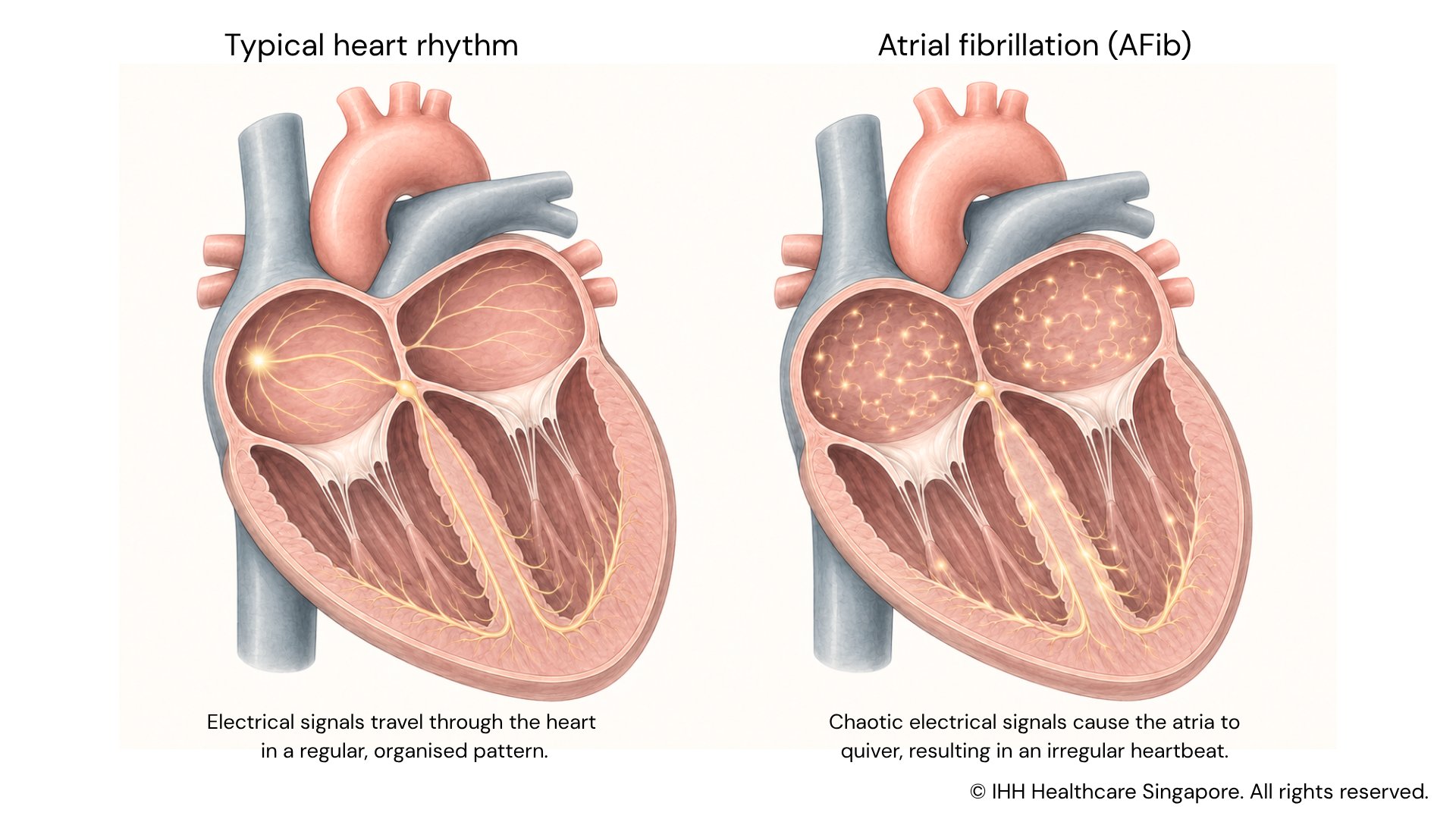
Atrial fibrillation, sometimes shortened to AFib or AF, is the most common type of heart arrhythmia – an irregular heartbeat caused by chaotic electrical signals in the heart's upper chambers (the atria). Instead of beating in a coordinated rhythm, the atria quiver rapidly and irregularly, which can cause the heart to beat too fast, too slow, or unpredictably.
Many people first notice AFib as a fluttering, pounding, or irregular heartbeat, though some people have no noticeable symptoms at all. Left untreated, AFib can increase the risk of stroke and heart failure, which is why timely diagnosis and management are important even in people who feel well.
How does AFib develop in the heart?
In a normally functioning heart, a single electrical signal from the sinus node spreads through the atria in an organised way, producing a steady, coordinated heartbeat.
In AFib, abnormal electrical impulses – frequently arising from tissue around the pulmonary veins – fire rapidly and chaotically, overriding the heart's natural pacemaker. This causes the atria to quiver rather than contract effectively, which is also why this specific area is the target of catheter-based treatments for AFib.
Types of atrial fibrillation
AFib is classified by how often it occurs and how long each episode lasts. This classification affects how your cardiologist approaches treatment:
- Paroxysmal AFib: Episodes come and go on their own, typically lasting anywhere from a few minutes to a few days, usually resolving within a week without treatment.
- Persistent AFib: Episodes last longer than 7 days and do not resolve on their own – medical treatment, such as cardioversion, is usually needed to restore normal rhythm.
- Long-standing persistent AFib: AFib that has continued for more than a year, but where restoring normal rhythm is still considered possible.
- Permanent AFib: AFib that has become the heart's ongoing rhythm, where the patient and doctor have decided not to pursue further attempts to restore normal rhythm, and treatment instead focuses on rate control and stroke prevention.
AFib is also described as progressive: without treatment, episodes often become more frequent and longer over time, and paroxysmal AFib can develop into persistent or permanent AFib.
Atrial fibrillation vs. other heart arrhythmias
AFib is often confused with other irregular heart rhythms, but each has a distinct pattern and origin in the heart:
- Atrial flutter: Also originates in the atria and can cause similar symptoms, but the electrical signals are more organised and follow a predictable circular pattern, producing a rapid but typically more regular rhythm than AFib. The two conditions can occur together and are treated with similar approaches.
- Supraventricular tachycardia (SVT): A broader term for fast heart rhythms starting above the ventricles. Unlike AFib, SVT episodes tend to start and stop abruptly and are usually regular in rhythm.
- Ventricular arrhythmias: Originate in the heart's lower chambers (ventricles) rather than the atria, and are generally more immediately dangerous than AFib.
What are the symptoms of atrial fibrillation?
Symptoms of AFib vary widely between individuals and may include:
- An irregular, fluttering, or pounding heartbeat (palpitations)
- A racing heart rate
- Fatigue or reduced exercise tolerance
- Shortness of breath
- Dizziness or lightheadedness
- Chest discomfort or pain
- Weakness
Can you have AFib with no symptoms?
Yes – this is known as silent or asymptomatic AFib, and it is more common than many people realise. As the irregular rhythm may not always be felt, silent AFib is sometimes only picked up incidentally, during a routine ECG, a health screening, or through a wearable device. This matters clinically because the stroke risk associated with AFib is present whether or not a person feels symptoms, which is one reason doctors may recommend screening in older adults even without complaints of palpitations.
What causes atrial fibrillation?
AFib develops when the heart's normal electrical signalling is disrupted, most often by abnormal electrical activity originating near the pulmonary veins, where they connect to the left atrium. This can happen due to structural changes in the heart, other underlying heart conditions, or triggers outside the heart itself.
What are the risk factors for atrial fibrillation?
A number of factors increase the likelihood of developing AFib:
- Increasing age. Risk rises substantially from the 60s onwards.
- High blood pressure. One of the most common contributing conditions.
- Heart disease. Including coronary artery disease, heart valve disease, and prior heart surgery.
- Obstructive sleep apnoea. A frequently under-diagnosed condition strongly linked to AFib.
- Obesity. Associated with structural changes in the atria that promote AFib.
- Thyroid conditions. Both overactive and underactive thyroid can trigger AFib.
- Excessive alcohol consumption. Binge drinking can trigger acute episodes, sometimes referred to informally as "holiday heart".
- Family history. A genetic predisposition exists in some cases, particularly for AFib diagnosed at a younger age.
- Chronic conditions. Diabetes and chronic kidney disease are also associated with higher risk.
What are the complications of atrial fibrillation?
If left untreated or poorly controlled, AFib can lead to:
- Stroke
- Heart failure
- Chronic fatigue and reduced quality of life
- In rare, prolonged cases, a heart rhythm disorder called tachycardia-induced cardiomyopathy, where a persistently fast heart rate weakens the heart muscle over time
How do you manage AFib triggers and reduce your risk?
While some risk factors for AFib, such as age and family history, cannot be changed, several lifestyle and medical measures may help reduce your risk or the frequency of episodes:
- Managing high blood pressure and other heart conditions
- Getting screened and treated for obstructive sleep apnoea if you snore heavily or feel excessively tired during the day
- Limiting alcohol intake
- Maintaining a healthy weight
- Managing thyroid conditions
- Staying physically active, within levels advised by your doctor
This coverage checker is brought to you by Health Insured, an online resource that helps you understand your health coverage in Singapore.
This page has been reviewed by our medical content reviewers.
RELATED ARTICLES
View all
What Foods Are Good for Heart Health?
Our cardiologist and dietitian share what to eat, what to limit, and what else matters for a stronger heart.

What Does a Heart Attack Feel Like for Women?
A heart attack can feel and present differently for women. Our cardiologist at Gleneagles Hospital explains what to watch for, and why it's often missed.

Heart Disease in Women: Symptoms and Why It Is Often Missed
Heart disease is often thought of as a man's condition, yet cardiovascular disease accounts for 1 in 3 deaths among women in Singapore. Here’s how to recognise it early.

What is Your Pulse Telling You? Tachycardia Explained
Your heart rate could give you helpful information about your current health and clue you in on potential health problems such as abnormal heart rates, tachycardia, and bradycardia.

What Causes Heart Rhythm Disturbances in Children?
An irregular or unusually fast heartbeat in a child can be worrying. Learn what causes arrhythmia in children and when treatment may be needed.

What is Causing Your Chest Pain?
Is your chest pain a heart problem? Find out what is causing your chest pain, and how to tell when it's serious.
Need help?
For enquiries, please call
+65 6250 0000 (Orchard) or +65 6898 6898 (Novena)
For appointment bookings, please WhatsApp
+65 8111 7777 (Orchard) or +65 8111 5777 (Novena)


