


 Cancer Care
 Heart Health
 Bone Health
 Brain & Spine Care
 Transplant


Dr Tham Weng Keong Ivan
Radiation Oncologist


 Add as a preferred source on Google
Radiation Oncologist
Head and neck cancers – a group that includes cancers of the mouth, throat, voice box, and surrounding areas – are among the most demanding cancers to treat well.
The difficulty is less about whether they can be cured and more about where they are: the tumours sit among the nerves, glands, and muscles we depend on every day to eat, speak, breathe, and swallow. Treating them effectively while preserving those functions calls for a high degree of precision – which is exactly why recent advances in radiotherapy, including proton therapy, are drawing real interest from doctors and patients alike.
Wherever a tumour sits – in the mouth, throat, or voice box – it tends to be surrounded by the structures that let us swallow, taste, speak and produce saliva.
Oropharyngeal cancer – a type of throat cancer of the tonsils and the base of the tongue – is a clear example, developing in one of the most delicate regions of the body. For these cancers, treatment has always had to balance two goals at once: clearing the cancer effectively, while protecting the everyday functions that matter most to quality of life.
For many years, radiotherapy could achieve the first goal but often at a cost to the second – dry mouth, swallowing difficulty, and for some patients, a period of needing a feeding tube.
The arrival of intensity-modulated radiotherapy (IMRT) was a major advance, letting doctors shape radiation more closely around the tumour and spare more healthy tissue. Proton therapy represents the next step in that same direction: even greater precision.
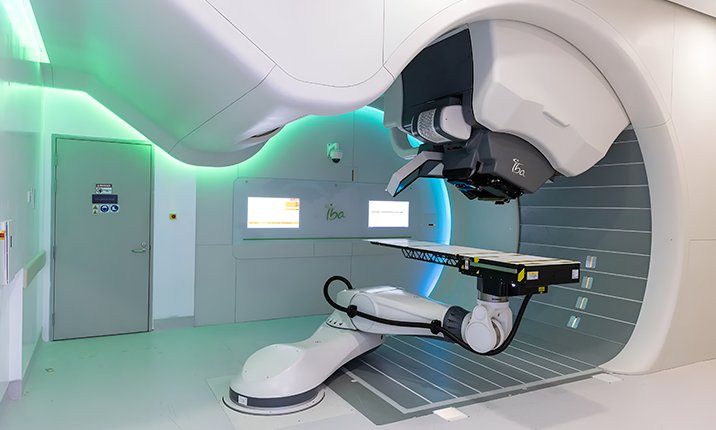
Traditional radiotherapy uses photons (X-rays) that pass all the way through the body, depositing radiation both on the way in and on the way out – including in healthy tissue beyond the tumour.
Proton therapy works differently. A proton beam releases most of its energy at a precise, controlled depth and then stops. There is no “exit dose” on the far side of the target. In practical terms, this allows doctors to concentrate the treatment on the tumour while reducing radiation to nearby healthy structures – the salivary glands, the swallowing muscles, and the lining of the mouth and throat.
For years, this advantage was mainly theoretical, supported by smaller studies. What has changed recently is the strength of the evidence behind it.
In the space of a few months, two large, rigorously designed Phase III randomised controlled trials – the highest standard of clinical evidence – have reported results comparing proton therapy with standard IMRT for oropharyngeal cancer.
Both trials studied oropharyngeal cancer specifically – cancer of the tonsils and base of the tongue – rather than all head and neck cancers. This is the subtype most commonly treated with proton therapy, which is why it was studied first.
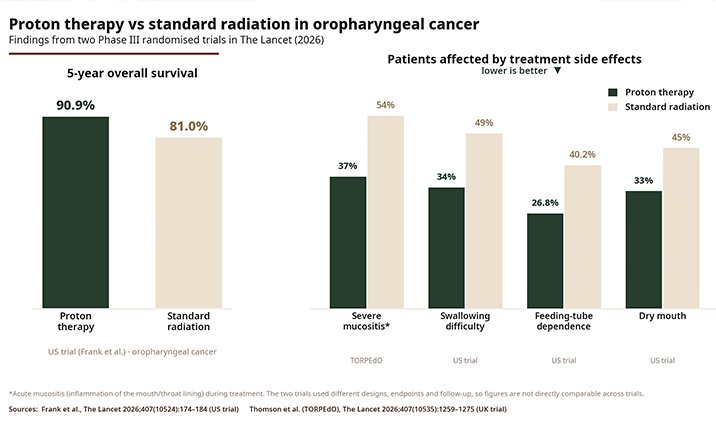
The first, led by the University of Texas MD Anderson Cancer Center and published in The Lancet in January 2026, was the largest of its kind: 440 patients across 21 sites. Its findings are notable.
Five-year overall survival was 90.9% among patients treated with proton therapy, compared with 81% for those receiving traditional radiation – a statistically significant difference. On the strength of these results, the researchers concluded that proton therapy represents a new standard-of-care option for advanced oropharyngeal cancer.
The second, the UK’s TORPEdO trial, also published in The Lancet in March 2026, was designed specifically to quality of life and side effects between the two techniques. It found that proton therapy could deliver excellent outcomes in this setting.
Together, these two trials move proton therapy from “promising in theory” to “supported by the strongest level of clinical evidence.”
For anyone going through treatment for head and neck cancer, survival is only part of the story.
Whether you can eat, swallow, and speak comfortably – during treatment and in the years that follow – shapes daily life profoundly. This is where the precision of proton therapy appears to offer real, tangible benefits.
In the US trial, patients treated with proton therapy were consistently less likely to experience some of the most difficult side effects of treatment.
They had lower rates of difficulty swallowing (34% versus 49%), feeding-tube dependence (26.8% versus 40.2%), and dry mouth (33% versus 45%) compared with standard radiation. They were also less likely to experience severe lymphopenia – a sharp drop in infection-fighting white blood cells – which may help the body better tolerate treatment.
The UK TORPEdO trial pointed in a similar direction during the treatment period itself. Patients receiving proton therapy had notably less severe mucositis – the painful inflammation of the mouth and throat lining that is one of the hardest parts of treatment – at 37% compared with 54% on standard radiation. Severe swallowing difficulty during treatment was also roughly halved (12% versus 24%). These improvements tracked with the lower radiation dose proton therapy delivered to the healthy tissues of the mouth.
The most reassuring takeaway for patients is this: both proton therapy and modern IMRT are excellent and effective treatments. As the lead investigator of the US trial put it, these trials overwhelmingly show that both are great treatment options.
What the new evidence adds is a clearer picture of where proton therapy’s advantages lie – particularly in reducing the burden of treatment and, in the larger US trial, in survival.
For patients, this makes the conversation with their care team richer and more informed. The right choice depends on the individual: their tumour, their anatomy, their overall health, and what matters most to them about their treatment and recovery.
Proton therapy is a specialised resource, and research is increasingly focused on identifying the patients who stand to gain the most from it. Based on current evidence and clinical experience, those who may benefit most often include patients with:
Proton therapy may not be the answer for every patient, and modern IMRT remains an outstanding treatment that cures the majority of people with this cancer. It is also worth remembering that this latest trial evidence is specific to oropharyngeal cancer; other head and neck cancers have not yet been studied in the same rigorous way, even if the overall direction is encouraging for the field.
But the direction of travel is clear: head and neck cancer care is becoming more precise, more personalised, and more focused not only on curing the cancer, but on protecting the quality of life in the longer term.

Standard radiation therapy (IMRT) uses X-ray photons that pass all the way through the body, leaving some radiation on both sides of the tumour. Proton therapy uses proton beams that release their energy at the tumour and then stop, with no exit dose beyond it. This allows doctors to spare more of the surrounding healthy tissue.
For oropharyngeal (throat) cancer, recent large trials show proton therapy matches standard radiation for survival and cancer control, while reducing some side effects of treatment. The right choice depends on the tumour’s location, the cancer type, and the individual patient.
Some side effects still occur, including skin irritation, mouth sores, sore throat and painful swallowing during treatment. However, effects such as severe dry mouth, swallowing difficulty and loss of taste tend to be less severe than with standard radiation, because less healthy tissue is exposed.
It can. By lowering the radiation dose to the salivary glands and swallowing muscles, proton therapy has been linked to less dry mouth and swallowing difficulty in some patients. In one large US trial of oropharyngeal cancer, fewer proton patients had difficulty swallowing (34% versus 49%) or dry mouth (33% versus 45%).
Some patients do, but the likelihood may be lower with proton therapy. In the US oropharyngeal cancer trial, feeding-tube dependence was less common with proton therapy (26.8%) than with standard radiation (40.2%), though findings vary between studies. Your care team will advise based on your situation.
Proton therapy is often considered for patients whose tumours sit close to critical structures, those who need to avoid re-irradiating a previously treated area, or those whose anatomy allows a meaningful reduction in radiation to healthy organs. A radiation oncologist can assess whether it is suitable.
Side effects can continue or even increase for 2 – 3 weeks after treatment ends, and it usually takes around four to six weeks for the body to begin healing. Following your care team’s guidance on mouth, throat and skin care, and on nutrition, supports a smoother recovery.
Yes. Proton therapy is available at the Mount Elizabeth Proton Therapy Centre, one of the earliest private proton therapy facilities in Southeast Asia. It is used for a range of cancers, including head and neck cancers.
Proton therapy services throughout Singapore are also under the purview of the Ministry of Health, which has a list of allowable indications for proton therapy.
Whether it is the right option for a particular patient depends on their diagnosis and treatment plan, which a radiation oncologist can advise on.
Head and neck cancer care is becoming more precise, more personalised, and more focused on protecting quality of life, not just in the short term, but for the years ahead. Our cancer specialists, including radiation oncologists at the Mount Elizabeth Proton Therapy Centre, are here to help you find the right path forward.
Learn more
A monthly breast self-examination 7 – 10 days after your period starts can save your life.

More women are being claimed by breast cancer now than before. Love them by encouraging them to go for breast screening.

Dr Tan Yah Yuen, general surgeon at Mount Elizabeth Hospitals, answers the questions you may have about mastectomies.

Dr Wee Siew Bock, breast surgeon at Mount Elizabeth Hospital, address your questions and concerns about breast conserving surgery (lumpectomy).

Dr Liau Kui Hin explains pancreatic neuroendocrine tumours (PNETs) and the newer, effective treatments for this uncommon cancer.

Dr Tan Yu-Meng, general surgeon at Mount Elizabeth Hospitals, gives us the stark facts about pancreatic cancer and the treatment options available for patients.

Our breast surgeon explains how to understand your risk, warning signs to know, why screening matters even when you feel well, and what surgery can look like today.

As knee osteoarthritis progresses, everyday activities can become more difficult. Our pain specialist and orthopaedic surgeon explain the treatment options available and how to find the right approach for you.

Dr Edwin Chng from Parkway Shenton explains why weight loss can slow down during medical weight management, and when it may be time to review your treatment plan.

Prostate cancer is common, often silent, and still diagnosed too late in Singapore. Urologist Dr Tan Yung Khan on what every man should know about screening, diagnosis, and treatment.

We answer common questions about haze, and how this can affect common chronic lung conditions such as asthma and chronic obstructive pulmonary disease (COPD), and 8 simple tips to protect ourselves against it.

Our neurosurgeon, Dr Vincent Ng, explains the factors specialists consider when deciding whether a brain aneurysm should be monitored or treated, and what the different treatment options involve.
Mount Elizabeth Hospitals are part of IHH Healthcare, one of the world’s largest integrated healthcare networks.

Download the MyHealth360 app to access an array of medical services conveniently.


Get trusted medical advice from our specialists, dietitians and physiotherapists directly in your inbox.
Subscribe